Last updated 2026-07-25
TL;DR
A condo reserve fund is money set aside for future big-ticket repairs (roofs, structure, plumbing). Florida condo associations 3+ stories must now fund reserves at 100% based on a Structural Integrity Reserve Study (SIRS), with no more waiving reserves for the SIRS-required items as of December 31, 2024, under Fla. Stat. 718.112.
What is a reserve study, and what is it for in an HOA or condo?
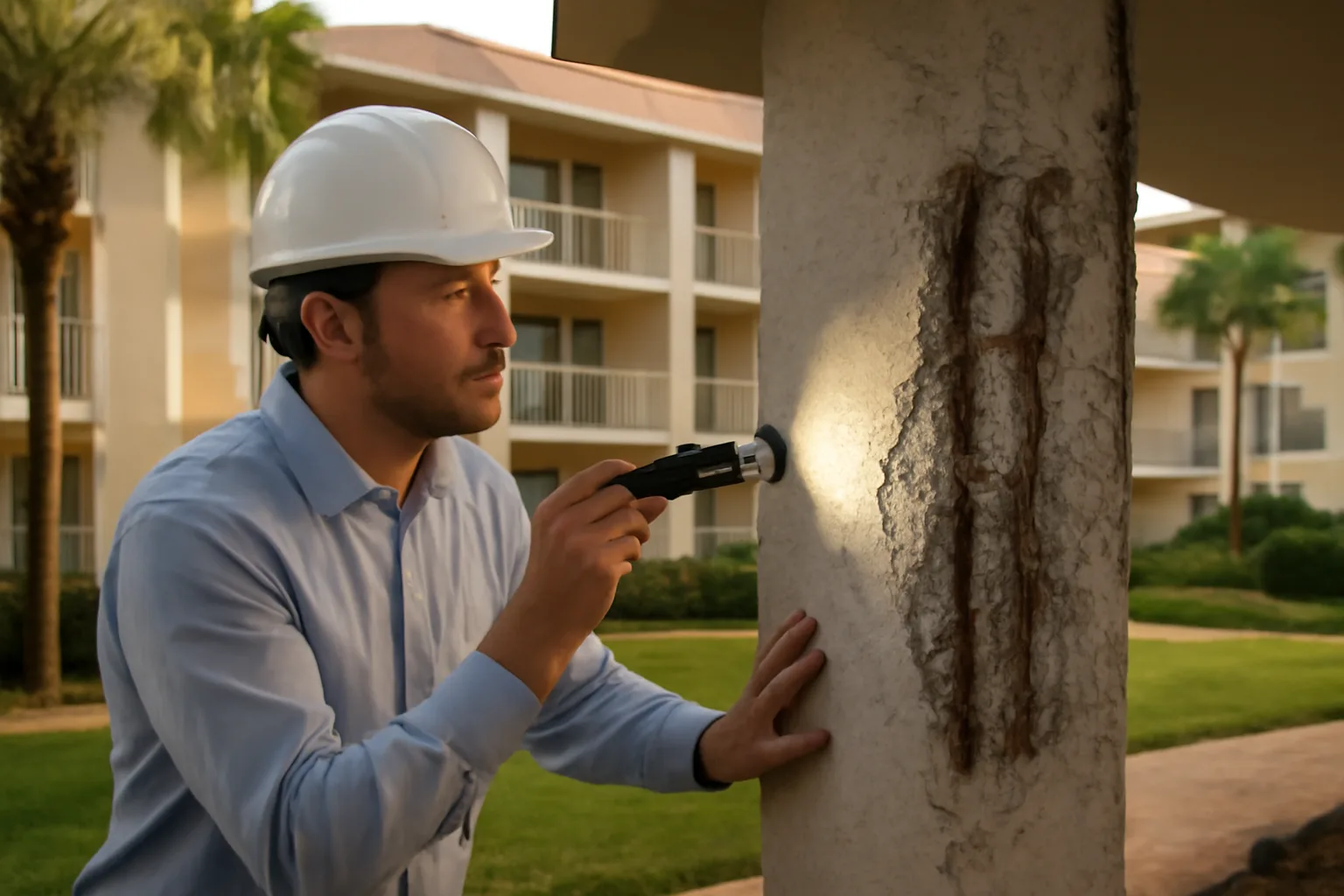
A reserve study is a report, usually done by an engineer or a reserve specialist, that walks a property's common elements (roof, pavement, structure, plumbing risers, elevators, pool decks) and estimates two things: how many years each item has left, and what it will cost to replace it. The output is a funding schedule that tells the board how much money to put aside each year so the cash is there when the roof actually needs replacing instead of surprising everyone with a special assessment. For a Florida condominium 3 stories or higher, the study that matters most right now is the Structural Integrity Reserve Study (SIRS), which is a specific, narrower version required by statute. A SIRS covers the load-bearing items only: roof, structure, fireproofing/fire protection, plumbing, electrical, waterproofing, and any item costing more than $10,000 to replace that would negatively affect habitability if left unaddressed. Fla. Stat. 718.112(2)(g) sets this out in detail [1]. HOAs (single-family and townhome communities not organized as condominiums) don't fall under the SIRS/condo reserve statute at all. There's no Florida law forcing an HOA to do a reserve study or fund reserves at any particular level; that's governed by the HOA's own declaration and Fla. Stat. ch. 720, which is far less prescriptive on reserves than ch. 718 is for condos. If your community is an HOA, a reserve study is still smart practice, just not a legal mandate the way SIRS is for condos. A general (non-SIRS) reserve study, the kind many condos and HOAs do voluntarily for items like paint, paving, fencing, and pool equipment, typically follows methods used across the reserve-study industry, and it's a good complement to a SIRS rather than a replacement for it. See our reserve study and HOA reserve study guides for the mechanics of each.
What is an HOA assessment, and how is it different from a reserve fund?
An HOA or condo assessment is simply the money owners are billed, usually monthly or quarterly, to fund the association's operations. Regular assessments cover day-to-day costs: landscaping, insurance, management fees, utilities for common areas, and contributions to reserves. A special assessment is a separate, often one-time bill charged when the regular budget and reserves can't cover a cost, like a sudden roof failure or a big repair that reserves didn't fully fund. Reserves are the savings account; assessments are how that account (and everything else) gets paid for. If a board underfunds reserves for years, owners eventually get hit with a special assessment instead, often for a much bigger number all at once. That's the exact dynamic Florida lawmakers were responding to after the Champlain Towers South collapse in Surfside in 2021, which killed 98 people and triggered the current SIRS and reserve-funding law [2]. For a deeper look at how special assessments work and what boards can (and can't) do procedurally, see our HOA special assessment explainer.
How much should a condo or HOA have in reserves?
There's no single dollar figure; the honest answer is 'enough to cover the funding schedule your reserve study or SIRS produces, at 100% of what that study says you need.' For Florida condos 3 stories and up, the law no longer gives boards a choice on the SIRS-covered items: as of December 31, 2024, associations must fund reserves for those components at full, statutorily-required levels, with no membership vote to waive or reduce them. Fla. Stat. 718.112(2)(f)4 states associations 'may not determine to provide no reserves or reserves less than required' for the items included in a SIRS [1]. Before this law, many Florida condos voted every year to waive reserves entirely, which is a big reason so many buildings arrived at their 30-year milestone inspection with empty accounts and a giant bill. That option is gone for SIRS items. Boards can still underfund or waive reserves for non-SIRS items (say, exterior painting or a clubhouse roof on a low-rise) if the membership votes to do so, but the structural, life-safety items are now mandatory funding. HOAs still have discretion. Fla. Stat. ch. 720 doesn't impose a SIRS or a mandatory funding percentage, so an HOA board and its members can legally choose to underfund reserves, though doing so just shifts risk to a future special assessment. A rough industry rule of thumb (not a legal standard) commonly discussed among reserve professionals is that a healthy reserve fund should be funded to at least 70% of its 'fully funded' target, though for Florida condo SIRS items the new legal floor is 100%, not 70%. Don't guess at this number. The whole point of the reserve study or SIRS is that a licensed professional runs the actual math on your building's specific components, ages, and local replacement costs.
How much does a reserve study cost in Florida?
Costs vary a lot by building size, number of components, and whether you're getting a full SIRS (structural-only) or a broader reserve study covering everything. As a rough range reported by Florida condo associations and reserve-study firms, a SIRS for a mid-size condo building often runs from roughly $5,000 to $15,000+, with larger, more complex, or older buildings costing more because there's simply more to inspect and model. A full general reserve study covering non-structural items too can add to that total. The SIRS must be performed by a licensed engineer or architect under Fla. Stat. 718.112(2)(g), which is one reason cost varies so much: engineering firms set their own rates, and coastal, high-rise, or structurally complex buildings take more site time than a small low-rise [1]. DBPR, which regulates community association managers and licensing in Florida, is a useful resource for confirming who is authorized to perform these inspections and studies [3]. Think of the study cost as cheap insurance against getting the funding schedule wrong. A $10,000 SIRS that accurately flags a $2 million roof and structural repair timeline is a bargain compared to finding out three years too late via a crumbling parking garage.
What does Florida's SIRS and reserve law actually require, and by when?
Florida condo associations with buildings 3 stories or higher must have completed a milestone structural inspection on the statutory schedule (generally by the building's 30th year, or 25th year if within 3 miles of the coast, and every 10 years after) and a SIRS at least every 10 years, per Fla. Stat. 553.899 and 718.112 [4] [1]. The SIRS must be done, and full (100%) reserve funding for its covered components must begin, with the reserve requirement effective for fiscal years starting on or after December 31, 2024. Here's the language directly from the statute on what's covered: the SIRS must include, at minimum, 'roof, load-bearing walls or other primary structural members, floor, foundation, fireproofing and fire protection systems, plumbing, electrical systems, waterproofing and exterior painting, and windows' along with any other item that costs more than $10,000 to replace and, if left unaddressed, 'has the potential to negatively affect the... structural integrity of the building' [1]. Missing these deadlines isn't a paperwork problem. Associations that don't complete the milestone inspection or SIRS on time can face liability exposure, insurer pushback, and difficulty selling units, since Florida now requires SIRS status and reserve disclosures in condo resale documents. If your building hasn't started this process, the milestone-inspections hub and DBPR's condominium guidance are the places to start, alongside your own engineer of record [3].
Are HOA or condo special assessments tax deductible?
Generally, no. Special assessments paid by individual condo or HOA owners for capital improvements, repairs, or reserve shortfalls are treated by the IRS like additions to the cost basis of your property, not as a deductible expense, in the same way you can't deduct a new roof on your personal home. This holds whether the assessment funds a new roof, structural repairs from a SIRS finding, or a special assessment tied to a milestone inspection. There are narrow exceptions. If the unit is a rental property, some portion of an assessment tied to repairs (as opposed to capital improvement) may be deductible as a business expense, and capital-improvement assessments generally get added to your basis, which reduces capital gains tax when you sell. The IRS discusses capital improvements versus repairs, and basis adjustments, in Publication 527 for rental property; homeowners should not assume anything is deductible without checking with a CPA, since the line between a repair and an improvement (and its tax treatment) is fact-specific [5]. This is genuinely a case where 'ask your accountant' isn't a dodge. Rental-property owners, primary-residence owners, and owners in a building that had a casualty loss (like storm damage) can all land in different tax treatment for the same dollar amount.
How do reserve requirements differ for HOAs vs. condos in Florida?
| SIRS required? | Yes, buildings 3+ stories [1] | No | |
|---|---|---|---|
| Milestone inspection required? | Yes, 30 yrs (25 if coastal), then every 10 [4] | No | |
| Can reserves be waived? | No, for SIRS items, as of Dec 31 2024 [1] | Yes, by membership vote (per governing docs) | |
| Reserve study required by law? | SIRS is mandatory; broader study optional | Not required by state law | |
| Typical study cost | ~$5,000-$15,000+ for SIRS | Varies, often less if non-structural only | Because the rules diverge this much, don't assume advice written for one type of association applies to the other. A board member who moves from managing an HOA to a condo board (or vice versa) needs to relearn the reserve rules from scratch. |
Condos (governed by Fla. Stat. ch. 718) now have a hard legal floor on structural reserve funding via SIRS. HOAs (governed by Fla. Stat. ch. 720) do not have an equivalent statewide mandate; reserve funding for an HOA is set by its own declaration and by whatever the board and membership vote to do each year. | Feature | Florida condo (ch. 718) | Florida HOA (ch. 720) |
What happens if a Florida condo board doesn't fund reserves properly?
Short term, nothing dramatic happens the day you miss a contribution. Long term, underfunded reserves mean the association has to either defer maintenance (which can worsen structural problems and drive up eventual repair costs) or hit owners with a special assessment, often in the tens of thousands of dollars per unit, when a big-ticket item fails. There's also a compliance angle now. Since SIRS reserve funding is mandatory for the covered structural components starting with fiscal years on or after December 31, 2024, a board that simply refuses to budget for it is exposing itself to potential breach-of-fiduciary-duty claims from owners, and buyers' lenders and title companies increasingly ask for SIRS and reserve documentation before closing. Florida also now requires certain reserve and SIRS-related disclosures in the documents given to prospective condo buyers. Boards juggling milestone inspection deadlines, SIRS completion, and reserve budgeting all at once often lose track of which deadline applies to their building's age and coastline distance. That's the exact gap our Board Compliance Kit is built for: a $199 one-time tool that organizes your building's specific milestone and SIRS deadlines, reserve line items, and required owner communications into one schedule, so the board isn't reconstructing statute citations from scratch every meeting. It doesn't replace your engineer or your attorney; it just keeps the paperwork and dates straight.
How should a board budget for and communicate a reserve funding increase?
Start with the SIRS or reserve study's funding schedule, then work backward to what that means per unit per month or year. Owners tolerate a phased increase far better than a shock special assessment, so if your reserves have been underfunded for years, ask your CPA or reserve specialist about a multi-year ramp-up rather than jumping straight to full funding in one budget cycle (check whether your declaration or the statute allows phasing; confirm with your association's counsel and county, since some local practices and lender requirements vary). Communicate early and often. Send owners the actual SIRS findings (or a plain-language summary), more than a new number on their bill. Boards that explain the 'why' (a licensed engineer found X, the statute requires Y, here's the payment schedule) get far less pushback than boards that just raise dues without context. Finally, get real bids. Reserve studies estimate future costs using regional cost data, but by the time you're actually doing the roof replacement or structural repair, get updated contractor bids rather than assuming the study's number is still accurate three or five years later. See our condo special assessment insurance piece if your building is weighing insurance products meant to smooth out special-assessment risk, and our reserve study for condo association guide and florida condo reserve fund relief piece if your association is exploring what legislative relief or phasing options currently exist.
Frequently asked questions
What is a reserve study?
A reserve study is a professional assessment of a building's major common-element components (roof, structure, plumbing, paving, etc.) that estimates remaining useful life and replacement cost for each, then produces a funding schedule telling the association how much to save each year. For Florida condos 3+ stories, the structural version, called a SIRS, is legally required under Fla. Stat. 718.112.
What is a reserve study for an HOA?
For an HOA, a reserve study serves the same purpose as for a condo (estimating future repair costs and building a savings schedule), but it's not legally required in Florida under ch. 720. HOAs adopt reserve studies voluntarily, or per their declaration, to avoid future special assessments on things like roads, fencing, or clubhouse amenities.
What is an HOA assessment?
An HOA assessment is a fee charged to owners to fund the association's budget: regular (recurring) assessments cover operating costs and reserve contributions, while special assessments are additional, often one-time charges for costs the regular budget and reserves can't cover, like an unexpected major repair.
How much should an HOA have in reserves?
There's no Florida statutory minimum for HOAs. The right amount is whatever your community's reserve study's funding schedule calls for; a commonly cited industry benchmark is funding to at least 70% of the 'fully funded' target, though many HOAs choose to fund at 100% if they want to avoid special assessments entirely.
How much should a condo have in reserves?
For Florida condos 3+ stories, the SIRS-covered structural items (roof, load-bearing walls, plumbing, electrical, waterproofing, and similar) must be funded at 100% of the amount the SIRS calculates, effective for fiscal years starting on or after December 31, 2024, per Fla. Stat. 718.112(2)(f)4. Non-SIRS items can still be underfunded if owners vote to allow it.
How much does a reserve study cost?
Costs vary widely by building size and scope. A SIRS for a Florida condo commonly runs roughly $5,000 to $15,000 or more, with larger or structurally complex buildings costing more because the engineer needs more site time and analysis. A broader reserve study covering non-structural items too adds to that cost.
Are HOA or condo special assessments tax deductible?
Generally no, for a primary residence. Special assessments are typically added to your property's cost basis rather than deducted, similar to a home improvement. Rental-property owners may get different treatment for repair-related portions; check IRS Publication 527 and talk to a CPA since the repair-versus-improvement distinction matters.
What is a SIRS and how is it different from a general reserve study?
A SIRS (Structural Integrity Reserve Study) is a Florida-mandated study limited to structural and life-safety components (roof, load-bearing elements, plumbing, electrical, waterproofing, fireproofing) for condos 3+ stories, per Fla. Stat. 718.112(2)(g). A general reserve study can cover everything, including paint, paving, and amenities, but isn't itself required by state law.
When did Florida's SIRS and reserve funding law take effect?
The SIRS requirement and the ban on waiving reserves for SIRS-covered items apply starting with association fiscal years beginning on or after December 31, 2024, under Fla. Stat. 718.112. Milestone inspection deadlines depend on building age and coastal proximity under Fla. Stat. 553.899.
Can a condo association still vote to waive reserves in Florida?
Not for SIRS-covered structural items, as of the fiscal years starting on or after December 31, 2024. Associations can still vote to waive or reduce reserves for non-SIRS components (like painting a low-rise exterior or a clubhouse), depending on the item and the association's declaration; confirm specifics with counsel.
Who can perform a SIRS in Florida?
A SIRS must be performed by a licensed engineer or architect, per Fla. Stat. 718.112(2)(g). DBPR oversees related licensing and condominium regulatory guidance; boards should verify credentials directly with the professional and confirm scope of work covers all statutorily required components.
Does an HOA need a milestone inspection like condos do?
No. Milestone structural inspections under Fla. Stat. 553.899 apply to condominium and cooperative buildings 3 stories or higher, not to HOAs. HOAs may still want independent structural or reserve assessments as good practice, but there's no statewide legal requirement forcing it.
Sources
- Florida Senate, Fla. Stat. 718.112: SIRS scope, mandatory 100% reserve funding for SIRS items starting fiscal years on/after Dec 31, 2024, and the $10,000 threshold definition
- NIST, National Construction Safety Team Act Investigation of Champlain Towers South Collapse (technical investigation overview, NIST NCSTAR): the 2021 Surfside condo collapse that prompted Florida's SIRS and reserve law changes
- Florida DBPR, Division of Florida Condominiums, Timeshares, and Mobile Homes: DBPR's role regulating and providing guidance on Florida condominium associations
- Florida Senate, Fla. Stat. 553.899: milestone inspection deadlines: 30 years generally, 25 years if within 3 miles of coastline, then every 10 years
- IRS, Publication 527 (Residential Rental Property): tax treatment distinctions between repairs and capital improvements affecting deductibility and basis for rental property owners