Last updated 2026-07-25
TL;DR
Florida Statute 553.899 requires buildings three stories or higher to get a milestone inspection by December 31 of the year they turn 30 (or 25 if a local agency requires it near salt water), then every 10 years. A related law, 718.112(2)(g), requires a Structural Integrity Reserve Study on the same 10-year cycle.
What is a milestone inspection in Florida, exactly
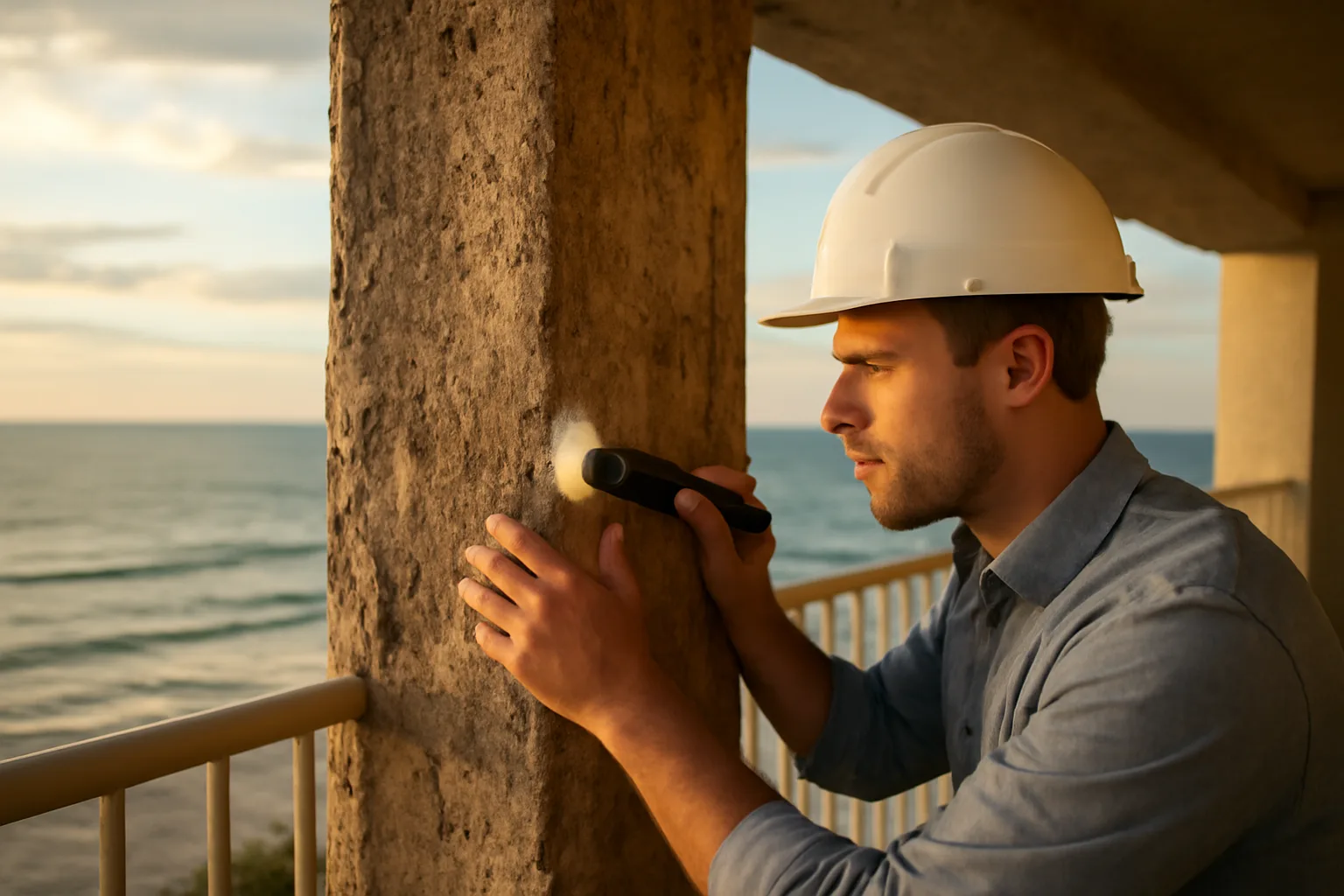
A milestone inspection is a structural check-up required by state law for condo and co-op buildings three habitable stories or taller. It exists because of one building: Champlain Towers South in Surfside, which partially collapsed on June 24, 2021, killing 98 people. Less than a year later, the Legislature passed Senate Bill 4-D, the Building Safety Act, signed on May 26, 2022, creating the statewide inspection and reserve framework that didn't exist before. The law itself lives in Florida Statute 553.899. It applies to any building three stories or more in height that's subject to condominium ownership under Chapter 718 or cooperative ownership under Chapter 719 [1]. It does not apply to single-family, two-family, three-family, or four-family homes with three or fewer habitable stories above ground, so a small non-condo townhome row is off the hook [1]. The inspection has to be done by a licensed architect or engineer. It's not a punch list job for a handyman and it's not something a board president can eyeball from the parking lot. The statute builds in two phases, and most buildings never get past Phase 1.
When is my building's milestone inspection due
The baseline rule: your first milestone inspection is due by December 31 of the year your building turns 30, counting from the date its certificate of occupancy was issued, and every 10 years after that [1]. So a building that got its CO in 1995 turns 30 in 2025, and the inspection is due by December 31, 2025. There's a transition rule for buildings that were already near or past that threshold when the law passed. If your building hit 30 years old before July 1, 2022, the initial inspection had to be done before December 31, 2024 [1]. If it turns 30 anywhere from July 1, 2022 through December 31, 2024, the deadline is December 31, 2025 [1]. Those two dates have already passed or are about to, so if your building falls in either bucket and you haven't started, you're behind, not early. Here's the wrinkle a lot of boards miss: local building departments can move the goalposts earlier. Under 553.899(3)(b), a local enforcement agency can require the initial milestone inspection at 25 years instead of 30, based on local conditions like proximity to salt water as defined in Florida Statute 379.101 [1]. Coastal counties use this. If your building sits near the Intracoastal or the beach, don't assume you get the full 30 years. Call your county building department and ask directly what age triggers your inspection.
What happens if my association can't meet the deadline
The statute has a real escape valve, but it only works if you're already moving. Under 553.899(3)(c), a local enforcement agency can grant a good-cause extension if the association already has a signed contract with an architect or engineer to do the inspection and it genuinely can't be finished in time [1]. Waiting until October to sign a contract for a December 31 deadline is not going to get you an extension; it's going to get you a violation notice. The law also lets agencies accept an older structural inspection report done before July 1, 2022, if it substantially complies with the milestone statute [1]. That can save money for buildings that already paid for a solid engineering report in the last few years. Ask your engineer to compare the old report against the current statute's Phase 1 requirements before you assume it qualifies.
How does the notification and 14-day clock work
Once a local enforcement agency decides your building needs a milestone inspection, it has to notify the association by certified mail, return receipt requested [1]. That's not a courtesy email. It's a formal legal notice, and it starts a clock. The association then has 14 days after receiving that notice to tell unit owners about the required inspection and its completion deadline [1]. Fourteen days is short. If your board doesn't already have a plan for who drafts that owner notice and how it goes out (mail, email blast, portal posting, whatever your governing documents require), figure that out now, not after the certified letter shows up. Boards that get caught flat-footed here usually also haven't budgeted for the inspection itself, which compounds the problem.
What's the difference between Phase 1 and Phase 2 inspections
| Phase 1 | Required for every building that owes a milestone inspection | Visual exam of habitable/non-habitable areas and major structural components [1] | 180 days after association receives agency notice [1] |
|---|---|---|---|
| Phase 2 | Only if Phase 1 finds substantial structural deterioration | Can include destructive or nondestructive testing of specific components [1] | Set case by case, no fixed statutory window |
Phase 1 is the mandatory first step for every building that owes a milestone inspection. A licensed architect or engineer does a visual examination of habitable and non-habitable areas and major structural components, and produces a qualitative assessment of the structure's condition [1]. It has to be completed, and the report submitted to the local enforcement agency, within 180 days after the association receives the agency's notice [1]. That's about six months, which sounds like a lot until you factor in scheduling a qualified engineer, getting access to every unit, and writing the report. Phase 2 only happens if Phase 1 turns up 'substantial structural deterioration' [1]. If the engineer doesn't find that, you're done after Phase 1, no destructive testing required. Phase 2 can involve more invasive testing, pulling core samples from concrete, that kind of thing, and it obviously costs more and takes longer. Most buildings in reasonable shape stop at Phase 1. The ones that don't are usually the ones with visible spalling, rust staining, or cracking that a Phase 1 engineer can't ignore. | Phase | Trigger | What it involves | Deadline |
What is a Structural Integrity Reserve Study (SIRS) and how is it different
A SIRS is a separate but related requirement under Florida Statute 718.112(2)(g). Residential condo associations must have one completed at least every 10 years after the condominium's creation, for each building three habitable stories or higher [2]. Where a milestone inspection asks 'is the structure safe right now,' a SIRS asks 'what will it cost to maintain and replace the big-ticket items over time, and are we saving enough.' The SIRS has to cover, at minimum: the roof; the structure itself (load-bearing walls and other primary structural members and systems); fireproofing and fire protection systems; plumbing; electrical systems; waterproofing and exterior painting; windows and exterior doors; and any other item with a deferred-maintenance or replacement cost over the statutory threshold that affects those components [2]. That threshold used to be $10,000. House Bill 913, signed by Governor DeSantis on June 23, 2025, raised it to $25,000 [3]. The Division of Condominiums has to adjust that $25,000 figure for inflation every year using the CPI-U, and post the updated number on its website by February 1, 2026, and annually after that. So don't hardcode $25,000 into your budget spreadsheet forever; check the current figure each cycle. Who can actually perform a SIRS matters too. It has to be done or verified by an engineer licensed under Chapter 471, an architect licensed under Chapter 481, or someone certified as a reserve specialist or professional reserve analyst by the Community Associations Institute or the Association of Professional Reserve Analysts [2]. And if the firm bidding on your SIRS also wants to bid on the repair work it recommends, they have to disclose that conflict in writing up front [2]. That's a real integrity provision most boards don't ask about until it's too late; ask any bidder directly whether they intend to also bid the repair contracts.
When is the SIRS deadline, and does it line up with the milestone inspection
As of the most recent DBPR guidance, the deadline to complete an association's initial SIRS is December 31, 2025. DBPR also says that if your milestone inspection is due on or before December 31, 2026, you can complete your SIRS at the same time as that milestone inspection. That's a real scheduling opportunity: the same engineer visiting your building for the milestone inspection can often gather much of what's needed for the SIRS too, saving on duplicate site visits and access coordination with owners. HB 913 also extended the SIRS completion requirement by a year and created a 2-year pause option for some reserve-fund contributions tied to repairs identified in a milestone inspection [3]. That pause option is meant to give associations facing a big milestone-driven repair bill some breathing room on separately building full reserves for that same item, but it's not a blanket delay of the whole SIRS. Ask your association's counsel whether your specific reserve items qualify before you assume you get the pause.
What is a reserve study, and is it the same thing as a SIRS
A reserve study, in the general sense, is a financial planning document that estimates the remaining useful life and future replacement cost of an association's major common-area components, then maps out how much money needs to be set aside each year to cover those costs without a surprise special assessment. Every HOA and condo association, in Florida or anywhere else, can benefit from one, whether or not state law requires it. A SIRS is a specific, legally defined version of that idea for Florida condo buildings three stories and up. It has a mandatory component list, a mandatory 10-year cycle, and mandatory credentialed preparers, none of which apply to a generic voluntary reserve study [2]. If you're on an HOA board (not a condo) or in a smaller building that's exempt from 553.899 and 718.112(2)(g), you can still commission a standard reserve study. It just won't be called a SIRS and won't carry the same statutory teeth. For a broader walkthrough of what a reserve study covers and how associations use one, see reserve study and hoa reserve study.
How much does a reserve study or SIRS cost
There's no statutory fee schedule for a SIRS or a general reserve study, and pricing varies a lot by building size, number of components, and whether Phase 2 testing gets triggered. Nobody publishes a single reliable statewide average, and boards should treat any quoted number as building-specific. Get at least two or three quotes from licensed engineers, architects, or CAI/APRA-certified reserve specialists, and ask each one to itemize what's included: site visits, component inventory, funding-plan modeling, and whether the milestone inspection data can be reused. What you can budget around with more confidence is the bigger picture: the milestone inspection itself (Phase 1, and Phase 2 if needed) is a separate cost from the SIRS, though combining site visits when your deadlines overlap (as DBPR allows for buildings due by December 31, 2026) can cut down on redundant engineering fees. For a full breakdown of what drives reserve study cost and how associations budget for it, see reserve study for condo association.
How much money should our association actually have in reserves
Florida's SIRS requirement doesn't set a single dollar target like 'have $500,000 in reserves.' Instead, it requires the study itself to calculate, component by component, what full funding looks like for your specific building, based on remaining useful life and current replacement costs [2]. A 40-year-old building with an aging roof and old plumbing needs a very different reserve balance than a 12-year-old building with the same square footage. What the law does constrain is underfunding. Associations can no longer simply waive or reduce SIRS-covered reserve line items by member vote the way they might have for non-SIRS items in the past; the required components have to be funded based on the study's findings. If your SIRS comes back showing a shortfall, the board's real options are raising regular assessments over time, a special assessment, or in some cases a line of credit or loan (which requires a majority vote of the total voting interests) to cover capital expenses tied to a milestone inspection or SIRS finding [2]. Waiting and hoping the number gets smaller next cycle is not a strategy; deferred maintenance almost always costs more later, not less.
What is an HOA or condo special assessment, and are they tax deductible
A special assessment is a one-time (or occasionally installment-based) charge a board levies on top of regular dues, usually to cover a specific capital need that regular reserves can't absorb: a new roof, major concrete restoration, a milestone-driven repair. It's different from your normal monthly or quarterly assessment, which funds ongoing operations and planned reserve contributions. On tax deductibility: for an individual owner who uses the unit as a personal residence, a special assessment generally isn't deductible as a personal expense, the same way regular HOA dues aren't. There are narrow exceptions, for example if the unit is a rental property (where assessments tied to operating expenses may be deductible as a business expense) or if a portion of the assessment funds a casualty-loss repair that qualifies under separate tax rules. This is genuinely a tax question, not a Florida statute question, and the right answer depends on your specific situation, so talk to a CPA before you assume either way. For more on how special assessments work operationally, see hoa special assessment and consider whether condo special assessment insurance makes sense for your building.
What has actually changed since the original 2022 law
The Building Safety Act (SB 4-D) that created this whole framework was signed on May 26, 2022. It hasn't stayed frozen since then. DBPR's own tracking identifies three rounds of amendments: Senate Bill 154 in 2023, House Bill 1021 in 2024, and House Bill 913 in 2025, each adjusting deadlines, reserve-funding rules, or reporting requirements. The most recent, HB 913, was signed on June 23, 2025, in Clearwater. Beyond raising the SIRS threshold from $10,000 to $25,000, it extended the SIRS completion deadline by a year and created that 2-year pause option on some reserve contributions tied to milestone-identified repairs [3]. Given how often this law has moved since 2022, treat any deadline you read (including in this article) as something to double-check against the current statute text and your county's interpretation before your board acts on it. For more on how the reserve-funding side of this has shifted, see florida condo reserve fund relief.
What should our board actually do this year
Start by pinning down two dates: your building's certificate-of-occupancy date, and whatever your county building department says your milestone trigger age is (30, or 25 if you're near salt water). Call the county directly. Don't rely on a neighbor's guess or a five-year-old newsletter. Next, find out if your milestone inspection and SIRS deadlines can be combined. If your milestone inspection is due by December 31, 2026, DBPR's guidance says you can complete your SIRS at the same time, which can mean one engineering engagement instead of two separate ones. Then get quotes early. Waiting until three months before a deadline to start looking for a licensed engineer or architect is how boards end up needing that good-cause extension under 553.899(3)(c) [1], which only works if you already have a signed contract in hand. Finally, get organized about the paperwork. Between the certified-mail notice, the 14-day owner communication window, the Phase 1 and possible Phase 2 reports, and the separate SIRS documentation, there's a real amount of scheduling and record-keeping that has nothing to do with engineering and everything to do with project management. That's the gap our $199 one-time Building-Specific Board Compliance Kit is built for: it organizes your building's specific deadlines, tracks notice requirements, and gives your board a communication template for owners, without touching the actual inspection or reserve study work, which has to stay with your licensed architect, engineer, or certified reserve specialist. You can build yours at /board-kit-builder. Whatever you do, run every deadline and every reading of this statute past your association's counsel and your county building department before you act. Statutes change (this one has changed three times since 2022), and county-level interpretation of the 25-year coastal trigger varies.
Frequently asked questions
What is a reserve study?
A reserve study is a report that estimates the remaining life and future replacement cost of a building's major shared components, then calculates how much an association should be saving each year to cover those costs. In Florida condo buildings three stories or higher, the state-mandated version is called a Structural Integrity Reserve Study (SIRS), required at least every 10 years under Fla. Stat. 718.112(2)(g).
What is a reserve study for an HOA?
For a homeowners association, a reserve study serves the same planning function as a condo's SIRS: it inventories shared assets (roads, clubhouses, pools, roofs on common buildings) and projects replacement costs and timing. Florida doesn't currently mandate a SIRS for most single-family HOAs the way it does for 3+ story condo buildings under Chapter 718, but a voluntary reserve study is still good financial practice.
How much does a reserve study cost?
There's no fixed statewide fee. Cost depends on building size, number of components tracked, and whether Phase 2 destructive testing gets triggered during a related milestone inspection. Get quotes from at least two or three licensed engineers, architects, or CAI/APRA-certified reserve specialists, and ask what's included before comparing prices.
How much should an HOA or condo have in reserves?
Florida law doesn't set one dollar figure; instead, the SIRS itself calculates full funding based on each component's remaining useful life and current replacement cost under Fla. Stat. 718.112(2)(g). A 40-year-old building needs a very different reserve balance than a 12-year-old one with the same square footage.
What are HOA or condo assessments?
Regular assessments are recurring dues that fund operations and planned reserve contributions. A special assessment is a separate, usually one-time charge levied to cover a specific capital need, like a milestone-inspection repair, that regular reserves can't absorb.
Are HOA special assessments tax deductible?
Generally no, for an owner using the unit as a personal residence, the same way regular dues aren't deductible. Rental property owners may be able to deduct assessments as a business expense, and casualty-loss-related portions may qualify under separate tax rules. Talk to a CPA about your specific situation.
When is the Florida milestone inspection deadline for my building?
The baseline is December 31 of the year your building turns 30, counted from its certificate of occupancy date, under Fla. Stat. 553.899(3)(a). Buildings that turned 30 before July 1, 2022 had a December 31, 2024 deadline; buildings turning 30 between July 1, 2022 and December 31, 2024 had until December 31, 2025. Some coastal counties require inspection at 25 years instead.
Does the milestone inspection law apply to my building?
It applies to buildings three habitable stories or higher subject to condominium ownership (Chapter 718) or cooperative ownership (Chapter 719), per Fla. Stat. 553.899. It doesn't apply to single-family, two-family, three-family, or four-family dwellings with three or fewer habitable stories above ground.
What's the difference between a milestone inspection and a SIRS?
A milestone inspection (Fla. Stat. 553.899) is a structural safety check by a licensed engineer or architect. A SIRS (Fla. Stat. 718.112(2)(g)) is a financial reserve-funding study covering roof, structure, plumbing, electrical, and other major components. They're on similar 10-year cycles and can sometimes be scheduled together.
What happens if a milestone inspection finds problems?
If the Phase 1 visual inspection finds no substantial structural deterioration, no further testing is required. If it does find substantial deterioration, a Phase 2 inspection follows, which can include destructive or nondestructive testing of specific components, under Fla. Stat. 553.899(7).
Can our association get more time to complete a milestone inspection?
A local enforcement agency can grant a good-cause extension if the association already has a signed contract with a qualified architect or engineer and the inspection genuinely can't be finished in time, under Fla. Stat. 553.899(3)(c). Waiting until close to the deadline to sign a contract generally won't qualify.
Who has to notify owners about a required milestone inspection, and how fast?
The local enforcement agency notifies the association by certified mail, return receipt requested. The association then has 14 days after receiving that notice to inform unit owners of the required inspection and its completion deadline, under Fla. Stat. 553.899(5).
What is the current SIRS reserve-item threshold, and will it change?
House Bill 913, signed June 23, 2025, raised the threshold from $10,000 to $25,000. The Division of Condominiums must adjust that figure annually for inflation using the CPI-U and post the updated number by February 1, 2026, and every year after, so check the current figure each cycle.
Sources
- The Florida Senate - 2025 Florida Statutes, Section 553.899: Milestone inspection deadline rules: 30-year baseline, transition deadlines, and exemption for small dwellings
- The Florida Senate - 2025 Florida Statutes, Section 718.112: SIRS required components, 10-year cycle, and qualified preparer requirements including bid-conflict disclosure
- Executive Office of the Governor - Press Release, June 23, 2025: HB 913 extended SIRS deadline by one year, created 2-year reserve-contribution pause option, raised threshold from $10,000 to $25,000
- Florida Senate: Statutory requirements for Structural Integrity Reserve Studies (SIRS) under Florida condominium law
- Florida Senate: Definitions and requirements for milestone inspections including Phase 1 and Phase 2 inspection procedures
- Florida Department of Business and Professional Regulation: DBPR oversight and guidance for condominium associations regarding milestone inspections and reserve requirements
- Internal Revenue Service: Tax treatment guidance relevant to whether special assessments are deductible
- Florida Senate: Original 2022 milestone inspection law establishing initial deadlines and requirements after the Surfside collapse
- Florida Senate: 2025 legislative changes amending milestone inspection and SIRS deadlines and requirements