Last updated 2026-07-25
TL;DR
A milestone inspection report is a written structural assessment of a Florida condo or co-op building over 3 stories, done by a licensed architect or engineer under Florida Statutes 553.899. Phase 1 is required at 25 years (30 if inland) and every 10 years after. Phase 2, a more invasive review, happens only if Phase 1 finds substantial structural distress.
What is a milestone inspection report in Florida?
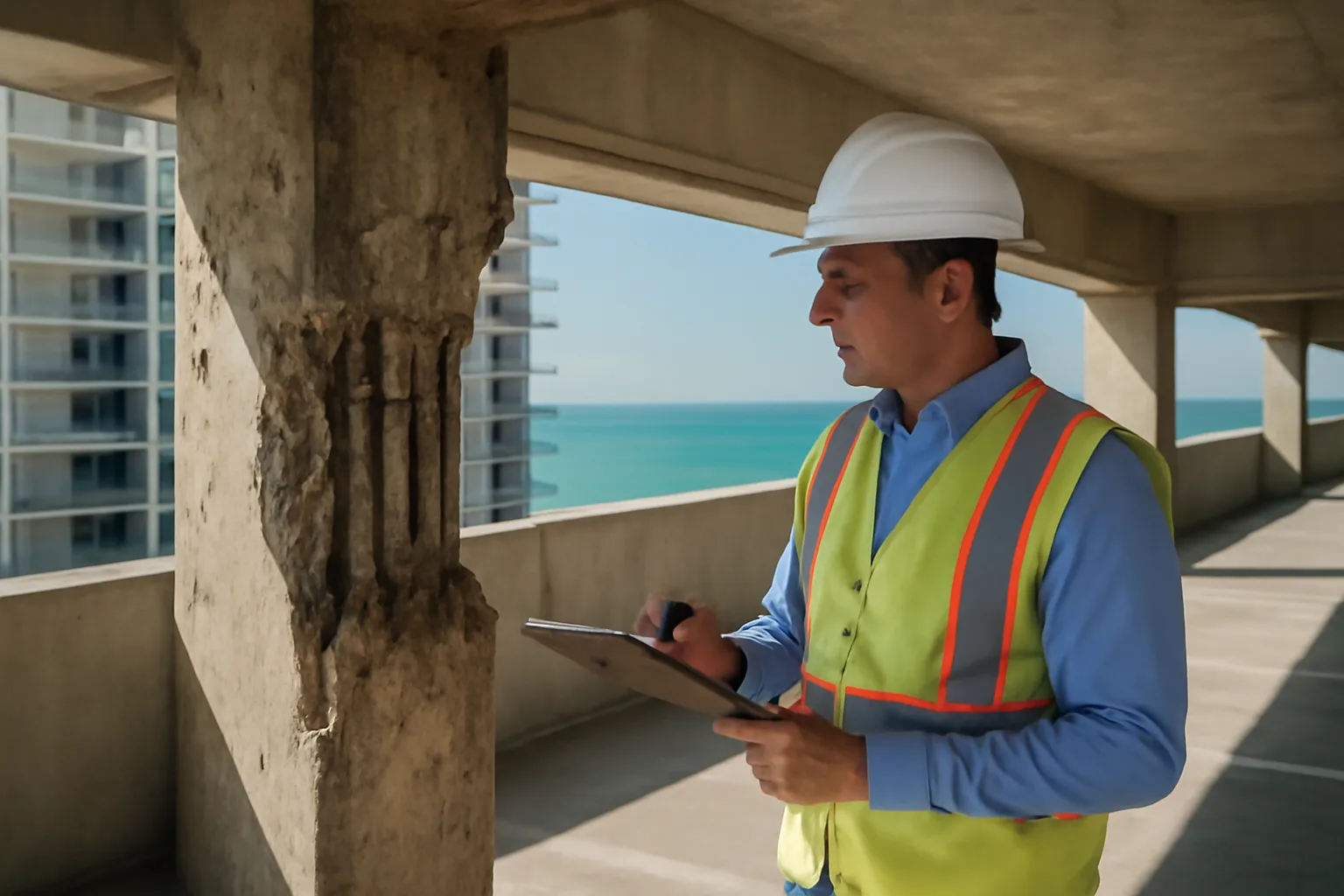
A milestone inspection report is the written product of a structural inspection that Florida law requires for condominium and cooperative buildings taller than three stories. A licensed Florida architect or engineer inspects the building's structural components, mainly the load-bearing elements and the primary structural systems, and writes up findings on whether there's "substantial structural deterioration" that needs repair. The statute governing this is Florida Statutes section 553.899, created after the Champlain Towers South collapse in Surfside in June 2021 [1]. The report itself isn't just a checklist. It has to include a statement on whether the inspector found signs of substantial structural deterioration, a summary of the findings, and recommended repairs if any are needed. Florida Statutes 553.899(8) requires the inspector to submit a sealed copy of the inspection report to the building official within 30 days after completing the inspection, and if unsafe conditions are found, the inspector must notify the building official immediately [1]. This is a two-phase process. Phase 1 is a visual inspection. Phase 2 only happens if Phase 1 turns up something concerning, and it's a deeper, sometimes destructive investigation. Most buildings never need Phase 2. If your board is just starting this process, the report you get back from Phase 1 is usually what people mean when they say "the milestone inspection report."
Which buildings need a milestone inspection in Florida?
Florida Statutes 553.899 applies to buildings that are three stories or more in height, and it covers condominiums and cooperative buildings specifically, not every commercial or residential structure. Single-family homes, duplexes, and most townhomes under three stories are outside the statute's scope entirely. Height is measured differently than most boards expect. The Florida Building Commission and DBPR guidance clarifies that story count, not raw footage, generally drives applicability, though local building officials make the final call for edge cases. If your building is a mixed-use structure with commercial on the ground floor and condo units above, ask your local building department directly rather than guessing, because that determination affects your legal deadline. The law also reaches buildings within 3 miles of the coastline differently than inland buildings, which matters for timing (covered in the next section). Local building officials in each county and municipality administer the inspection program, so procedural details, filing requirements, and enforcement can vary by jurisdiction even though the underlying statute is the same statewide [1].
When is a milestone inspection due, at 25 or 30 years?
The deadline depends on how close your building sits to the coast. Under Florida Statutes 553.899(3), a building located within 3 miles of a coastline must complete its initial milestone inspection by the time it reaches 25 years of age, and then every 10 years after that. A building located more than 3 miles from the coastline gets 30 years for its initial inspection, with the same 10-year recurring cycle after [1]. Age is measured from the date the certificate of occupancy was issued, not from when construction started or when the building was sold out. For buildings that were already older than the threshold when the law took effect on July 1, 2022, the statute set staggered deadlines based on when the certificate of occupancy was issued, generally requiring inspection by December 31, 2024 for the oldest buildings, with local building officials able to adjust timing based on inspection backlogs [1]. Boards frequently get this wrong by counting from the wrong start date or assuming their county gave them more time. Confirm your building's exact certificate of occupancy date and your county's specific enforcement deadline with your association's counsel, because local building departments in Miami-Dade, Broward, and other coastal counties have issued their own notices and in some cases their own earlier deadlines that predate the 2022 statewide law [1].
What is Phase 1 vs Phase 2 of a milestone inspection?
Phase 1 is a visual structural examination performed by a licensed architect or engineer, and for most buildings, this is the entire inspection. The inspector walks the site, reviews accessible structural components, and produces a report stating whether they observed substantial structural deterioration. Phase 2 only triggers if Phase 1 finds evidence of that deterioration. Florida Statutes 553.899(9) defines "substantial structural deterioration" as substantial structural distress that affects a building's structural integrity, not routine wear like cosmetic cracking or minor spalling [1]. If the Phase 1 inspector finds this level of distress, Phase 2 requires more invasive testing, which can include exploratory demolition, opening walls, or lab testing of core samples to figure out the extent of the problem and what repair is needed. Phase 2 costs more and takes longer, sometimes months longer, because it usually needs staged access, sometimes unit-by-unit entry, and follow-up engineering analysis. If your board gets a Phase 1 report back clean, you're done until the next 10-year cycle. If it flags distress, budget for both the Phase 2 investigation cost and, more importantly, whatever repair work comes out of it, which is often the far bigger number.
What does a milestone inspection report actually include?
A completed milestone inspection report has to include a few required elements under 553.899(8): a statement on whether the inspector observed substantial structural deterioration, photographs of any deterioration found, recommendations for necessary repairs, and for Phase 2 reports, more extensive documentation of testing and findings [1]. Most licensed engineers structure the report around the building's structural systems: foundation, load-bearing walls and columns, floor and roof structural members, and any exposed structural steel or concrete elements exposed to the elements (balconies, exterior walkways, parking structures). Cosmetic issues, plumbing, electrical, and non-structural elements usually aren't the focus unless they intersect with a structural finding. The report gets filed with the local building official, and under the statute, the board must also distribute a copy or a summary to unit owners. Some counties require it be posted or provided within a specific number of days of receipt; check your local building department's published guidance since this detail isn't uniform statewide [1]. Boards should also keep the sealed report as a permanent association record, since it becomes part of what future buyers, lenders, and insurers ask to see.
How much does a milestone inspection cost?
There's no single statewide fee schedule because it's a private contract between the association and a licensed architect or engineer, and prices vary by building size, complexity, and region. Boards report a wide spread, generally in the range of a few thousand dollars for smaller buildings to tens of thousands for larger, more complex coastal towers, though nobody publishes reliable statewide averages and DBPR doesn't set or track pricing. What drives cost: number of stories, total square footage, number of separate structural systems (parking garage, seawall, multiple wings), and how much destructive testing Phase 2 requires if triggered. A 3-story inland building with a simple footprint costs meaningfully less than a 20-story oceanfront tower with an attached parking structure and pool deck. Get at least two or three quotes from Florida-licensed engineers or architects who specifically do milestone inspection work, since this has become a specialized niche since 2022 and demand has outpaced supply of qualified inspectors in some markets. Ask each firm for their timeline commitment in writing, because scheduling delays, not the inspection cost itself, is what causes most boards to miss their statutory deadline.
What is a reserve study?
A reserve study is a professional analysis of a building's major common-area components, their remaining useful life, and the cost to repair or replace them, used to calculate how much money an association should be setting aside in reserves. It's a separate document from a milestone inspection, though the two often get confused because both involve engineers evaluating a building's condition. A reserve study typically inventories items like roofing, painting, pavement, structural components (which now overlaps with the SIRS requirement discussed below), plumbing, and other capital items with a useful life over a set number of years, then models a funding schedule to pay for those replacements when they come due. Florida's Structural Integrity Reserve Study (SIRS) requirement, created by the same post-Surfside legislation, specifically mandates a reserve study focused on structural components for condominiums 3 stories or higher, separate from the general reserve study many associations already do for non-structural items [2]. For a full breakdown of what's inside a SIRS and how it differs from a general reserve study, see our reserve study guide.
What is a reserve study for an HOA, and how much does it cost?
For an HOA (as opposed to a condo association), a reserve study serves the same underlying purpose: an engineer or reserve specialist walks the property, catalogs shared capital assets (roofs, pools, clubhouses, roads, drainage systems), estimates each item's remaining life and replacement cost, and produces a funding plan so the HOA isn't blindsided by a $200,000 roof replacement with $12,000 in the bank. Cost for a reserve study generally runs from around $3,000 to $10,000 or more depending on property size and complexity, though this varies widely by region and by whether it's a "full" study (with an on-site visual inspection) versus an "update" study (a desktop refresh of an existing study). Larger properties with more distinct capital components cost more because there's simply more to inventory and model. Most HOAs aren't currently required by Florida statute to complete a SIRS the way condominiums are (SIRS under 553.899 and 718.112 applies specifically to condo and cooperative associations), but many HOAs voluntarily commission reserve studies anyway because it's good financial practice and increasingly expected by lenders and insurers. Check with your association's counsel on whether any local ordinance or your governing documents impose a separate requirement. See our HOA reserve study page for a full walkthrough.
What is an HOA assessment, and how much should reserves hold?
An HOA assessment is a fee the association charges each owner to fund shared expenses, either a regular (recurring) assessment for operating costs and reserves, or a special assessment, a one-time or limited-run charge to cover an unexpected or large expense the regular budget doesn't cover. Both are authorized through the association's governing documents and, for condos, through Florida Statutes chapter 718. There's no single statewide dollar or percentage rule for "how much an HOA should have in reserves," because it depends entirely on the age, size, and component inventory of the property. The best practice, reflected in how reserve specialists build funding plans, is to fund reserves at a level that keeps the reserve balance reasonably close to the total accumulated depreciation of major components, often described as a target "percent funded" ranging from 70% to fully funded, though many U.S. associations run well below that. For Florida condominiums specifically, Florida Statutes 718.112(2)(f) requires reserves for items covered by a SIRS to be funded based on the study's findings, without the option to waive or reduce SIRS-based reserve funding through a membership vote, a rule that took effect for most associations at the start of 2025 [2]. This is a meaningfully stricter standard than the old system, where owners could vote annually to waive or reduce reserve contributions. Our reserve study for condo association piece breaks down the funding math in more detail.
Are HOA special assessments tax deductible?
Generally, no, special assessments paid by individual condo or HOA owners for capital improvements or major repairs are not tax deductible on a personal federal return, because the IRS treats them as a capital expense that adds to the cost basis of your property rather than a deductible expense, similar to how a home improvement isn't deductible [3]. There are narrow exceptions. If a special assessment is genuinely for repairs or maintenance (not improvement) on a property you rent out, it may be deductible as a rental expense, and if part of an assessment funds something like a casualty-loss repair after a federally declared disaster, different rules can apply. This is a real tax question with real dollar consequences, so don't rely on a blog post (including this one) to make that call. Talk to a CPA who handles real estate before assuming either way. Regular monthly HOA dues aren't deductible for a personal residence either, with the same rental-property exception. IRS Publication 527 covers rental property expense rules if you're trying to figure out where a specific assessment falls [3].
What happens if a building fails a milestone inspection?
There's technically no "pass or fail" grade on a milestone inspection. What happens instead is the inspector documents findings, and if they find substantial structural deterioration, that triggers Phase 2 and a repair obligation. The building doesn't get shut down just because Phase 1 flags a concern, unless the local building official separately determines the structure is unsafe for occupancy, which is a distinct and more serious finding under the building official's general authority, not something automatic under the milestone statute itself. If repairs are required, the association has to fund them, usually through a combination of reserves (if adequately funded) and a special assessment on unit owners. This is where the milestone inspection process connects directly to the reserve and assessment planning discussed above. Boards that get a bad Phase 1 report with no reserve cushion are the ones facing the largest, most disruptive special assessments, sometimes tens of thousands of dollars per unit with short payment windows. If your board is staring down a milestone deadline, a SIRS requirement, and a possible special assessment all at once, organizing the paperwork, deadlines, and owner communications is its own project on top of the actual engineering work. That's the specific gap our $199 one-time Board Compliance Kit is built to fill: it doesn't replace the licensed engineer's inspection or reserve study, but it helps a volunteer board track deadlines, organize required disclosures, and communicate the timeline to owners without missing a filing date.
How does a milestone inspection relate to a SIRS?
A milestone inspection and a SIRS are two separate legal requirements that often get triggered around the same time for the same building, which is a major source of board confusion. The milestone inspection under 553.899 is a structural safety inspection focused on identifying deterioration. The SIRS under Florida Statutes 718.112(2)(g) is a reserve funding study focused on planning and paying for the replacement of specific structural and safety components (roof, load-bearing walls, primary structural systems, fireproofing, electrical systems serving common areas, plumbing, waterproofing, and a handful of other items enumerated in the statute) over their useful life [2]. They use similar language, both involve a licensed professional inspecting the building, and both came out of the same 2022 legislative response to Surfside. But one tells you if there's a structural problem right now (milestone), and the other tells you how much money you need to be setting aside so a future replacement doesn't require a crisis special assessment (SIRS). A condo board can, and often should, coordinate timing so the engineer doing the milestone inspection and the firm doing the SIRS aren't duplicating site visits, since some of the physical inspection work overlaps. But legally, satisfying one doesn't satisfy the other. Check with your engineer and your association's counsel on how your specific building's timeline lines up. For the deeper mechanics of a SIRS filing, see our reserve study guide, and for special-assessment planning once repair costs are known, our HOA special assessment and condo special assessment insurance pages walk through funding options.
Frequently asked questions
What is a milestone inspection report in Florida?
It's the written report a licensed architect or engineer produces after inspecting a Florida condo or co-op building over 3 stories for structural deterioration, required under Florida Statutes 553.899. It states whether substantial structural deterioration was found and, if so, triggers a deeper Phase 2 review and required repairs.
Who has to get a milestone inspection in Florida?
Condominium and cooperative buildings that are 3 stories or taller must comply, per Florida Statutes 553.899. Single-family homes and most low-rise HOAs aren't covered. Coastal buildings (within 3 miles of the coastline) face a 25-year initial deadline, and inland buildings get 30 years, with recurring 10-year inspections after.
What is a reserve study?
A reserve study is a professional evaluation of an association's major shared components (roof, pavement, structural systems, and similar items), their remaining useful life, and replacement cost, used to build a funding plan so the association can pay for future repairs without a surprise special assessment.
What is a reserve study for an HOA?
It's the same core process applied to a homeowners association: an inspector catalogs shared capital assets like roofs, roads, pools, and clubhouses, estimates when each needs replacement, and calculates how much the HOA should be saving now. Most HOAs aren't legally required to do one under Florida's condo-specific SIRS law, but many do it anyway as good financial practice.
What is an HOA assessment?
An HOA assessment is a fee charged to owners to fund the association's shared expenses. Regular assessments cover routine operating costs and reserve contributions; special assessments are one-time or limited charges for unexpected or large expenses, like a major repair, that the regular budget can't absorb.
How much should an HOA have in reserves?
There's no single statewide dollar figure. Reserve specialists generally aim to keep the reserve balance close to the building's accumulated depreciation on major components, often targeting 70% funded or higher, though there's no legal minimum percentage for most HOAs. For Florida condos, SIRS-covered items must be funded per the study's findings starting under 718.112(2)(f).
How much does a reserve study cost?
Reserve studies generally run from roughly $3,000 to $10,000 or more, depending on property size, number of components, and whether it's a full on-site study or a desktop update. Larger, more complex properties with more capital components cost more because there's simply more to inventory.
Are HOA special assessments tax deductible?
Generally no. Special assessments for capital improvements or major repairs typically add to your property's cost basis rather than qualifying as a deductible expense, per IRS rules covered in Publication 527. Rental-property owners may have narrower deductions available. Confirm your specific situation with a CPA.
What's the difference between Phase 1 and Phase 2 of a milestone inspection?
Phase 1 is a visual structural inspection performed by a licensed architect or engineer, and most buildings never go beyond it. Phase 2 only triggers if Phase 1 finds substantial structural deterioration, and it involves more invasive testing, sometimes including exploratory demolition or lab analysis of building materials.
Is a milestone inspection the same as a SIRS?
No. A milestone inspection (Florida Statutes 553.899) checks for structural deterioration right now. A SIRS (Florida Statutes 718.112(2)(g)) is a reserve funding study that plans and budgets for future replacement of structural and safety components. Both often apply to the same building around the same timeline, but they are separate legal requirements.
What happens if my building's milestone inspection finds structural problems?
The inspector's finding of substantial structural deterioration triggers a required Phase 2 investigation, which is more invasive and determines the extent of the problem and needed repairs. The association then has to fund those repairs, typically through reserves, a special assessment, or both, depending on how well-funded reserves already are.
How is a building's age calculated for milestone inspection deadlines?
Age is measured from the date the building's certificate of occupancy was issued, not from the construction start date or first sale. Buildings within 3 miles of the coast need their first inspection by 25 years; inland buildings get 30 years, and both recur every 10 years after.
Does every condo building in Florida need a milestone inspection?
Only condo and cooperative buildings that are 3 stories or higher fall under Florida Statutes 553.899. Two-story condo buildings and single-family HOA communities generally aren't covered by this specific statute, though local building codes or your county may impose separate requirements, so check with your building official.
Sources
- Florida Senate, Florida Statutes 553.899: Milestone inspection statute created after the Surfside collapse, covering condo and co-op buildings over 3 stories
- Florida Senate, Florida Statutes 718.112(2)(g): Structural Integrity Reserve Study requirement for condominiums 3 stories or higher
- IRS, Publication 527, Residential Rental Property: Special assessments for capital improvements generally add to cost basis rather than being deductible; rental property has narrower exceptions
- Florida Senate: Homeowners' associations are subject to reserve study and reporting requirements under Florida Statute 720.30755
- Florida Senate: The milestone inspection statute establishes the 25-year and 30-year inspection timelines depending on proximity to the coastline
- Florida Department of Business and Professional Regulation (DBPR): DBPR guidance clarifies what a milestone inspection report must include and how Phase 1 and Phase 2 inspections differ
- IRS Publication 530: IRS guidance on tax treatment of homeowner association assessments and special assessments
- Florida Senate: Statutory qualifications required for licensed engineers or architects to perform milestone inspections